Bimodal Network Graphs
of Crowdfunded Literary Patronage
Two Views of Black Britons Publishing in the Eighteenth Century
Association for Computers and the Humanities
June 24-26, 2026
Entity resolution of subscriber lists
From printed page to network, with rules-based logic
A subscriber is akin to a "backer" in a crowdfunding campaign: they paid in advance so the author could afford their print run, and are thanked in a list.
Eighteenth-century subscriber lists offer a rare and exciting documentary trace of the thousands of ordinary readers who are often elusive in book history. To learn which books shared audiences, however, requires interpretive work which has previously not been pragmatic to undertake at scale. In this poster, I present a rules-based Python pipeline, hyper-specialized to the eighteenth-century context, which can take in PDFs of eighteenth-century printed namelists and produce network graphs of shared list members.
The process begins with tuned, Kraken-based Optical Character Recognition (OCR) of the printed pages, which discards non-name information like headings. My pipeline then identifies the order of first and last names in the list, normalizes names -- expanding abbreviations, fixing common OCR errors, imposing a standardized form for various social titles -- and then parses the names into structured fields.
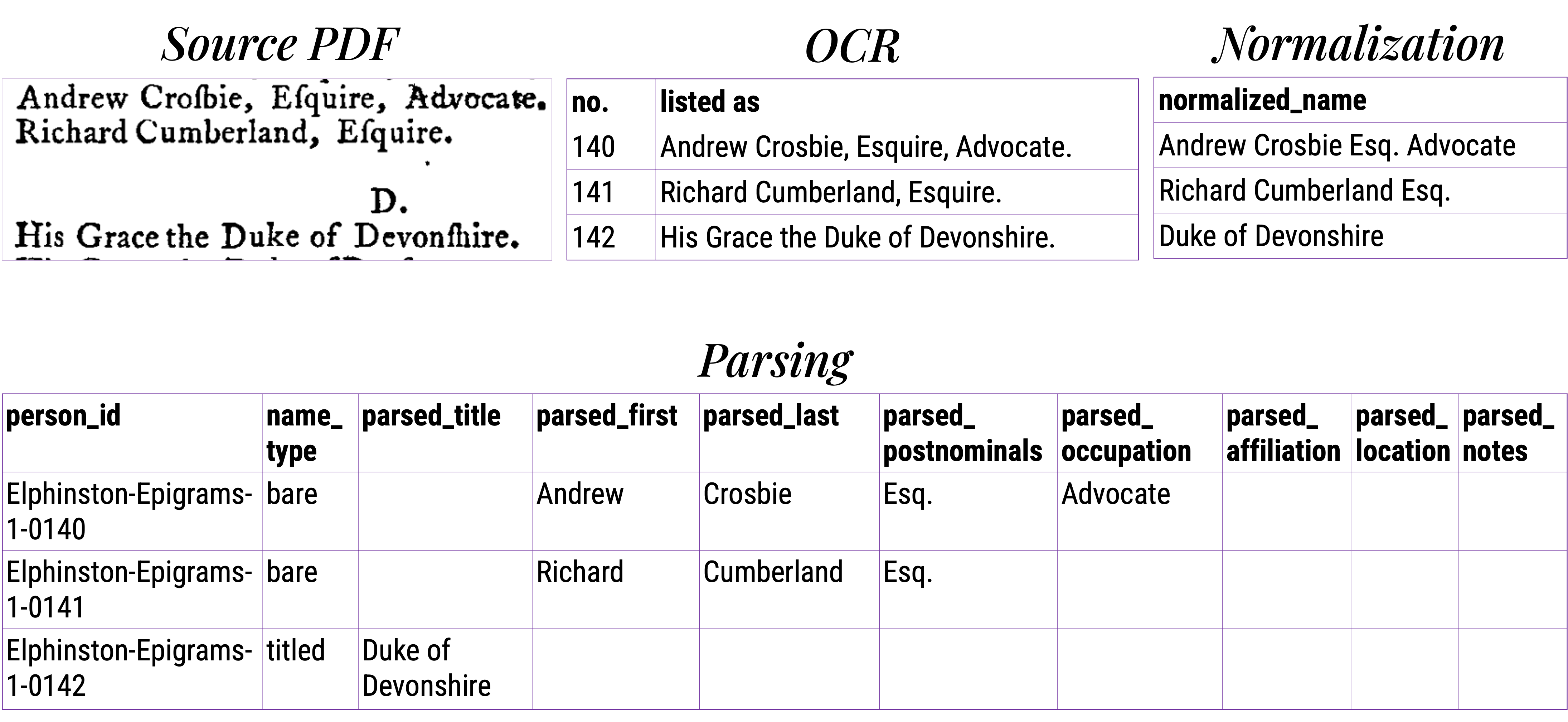
The next step is entity resolution, to identify that (for example) "Admiral George Balfour" and "Admiral Geo. Belfour" are almost certainly the same person. Simple text-similarity measures like edit distance are very ill-suited to this problem space: "Earl of Aylesbury" and "The Right Honourable Earl of Aylesbury" are (in any given year) the same person with no ambiguity, but as strings of text the edit distance is enormous. Instead, I turn to rules-based, context-specific parsing to use the identifying infomation within each name.
My entity resolution logic encodes a range of heuristics. Peerage titles held by only one person at a time are specifically detected and matched automatically. For other names, if there is enough information to potentially identify a unique individual — for example, a "distinctive" title like "Reverend" with the same first name and last name — they are presented for manual review. If some elements only match weakly (say, "John" and "J." as the first names, or "Mr." in one list but "Esq." in another), but other matches give a strong signal of overlap (such as a specific location or occupation), these other signals contribute to a probability score and may also lead to a proposed match. To account for spelling variation (and messy OCR), last names use a fuzzy match whose tolerance scales with name length — one character’s difference for short surnames, up to three for long ones — and which only fires when at least one other signal suggests a possible match. Certain kinds of conflicts will always block a match: two entries in the same edition, or incompatible first names, locations, or titles.
Because the rules are explicit rather than relying on machine learning, the process is auditable, and with transparent logic behind each identification. The auto-matching works in parallel with a manual review of ambiguous candidates; these manual matches are saved to be re-used on future lists.
Subscriber lists of 1782
Where Sancho’s Letters sits among that year’s subscription books
A particularly notable subscriber list is that of the Black Briton Ignatius Sancho, whose posthumous Letters (1782) became an important part of public debates around the abolition of slavery. I ask: how does his book, and his subscriber list, "fit" with the other books of the year?
In 1782, at least 42 books were published by subscription in the United Kingdom; I have located digital facsimiles of 35 of them, which together contain 16,720 distinct entries. Checking these lists for specific individuals of historical interest is easy, but "distant reading" them — for example, identifying which books share the most subscribers with each other — requires something on the order of a hundred million pairwise judgments. Making a computer do it is the only way.
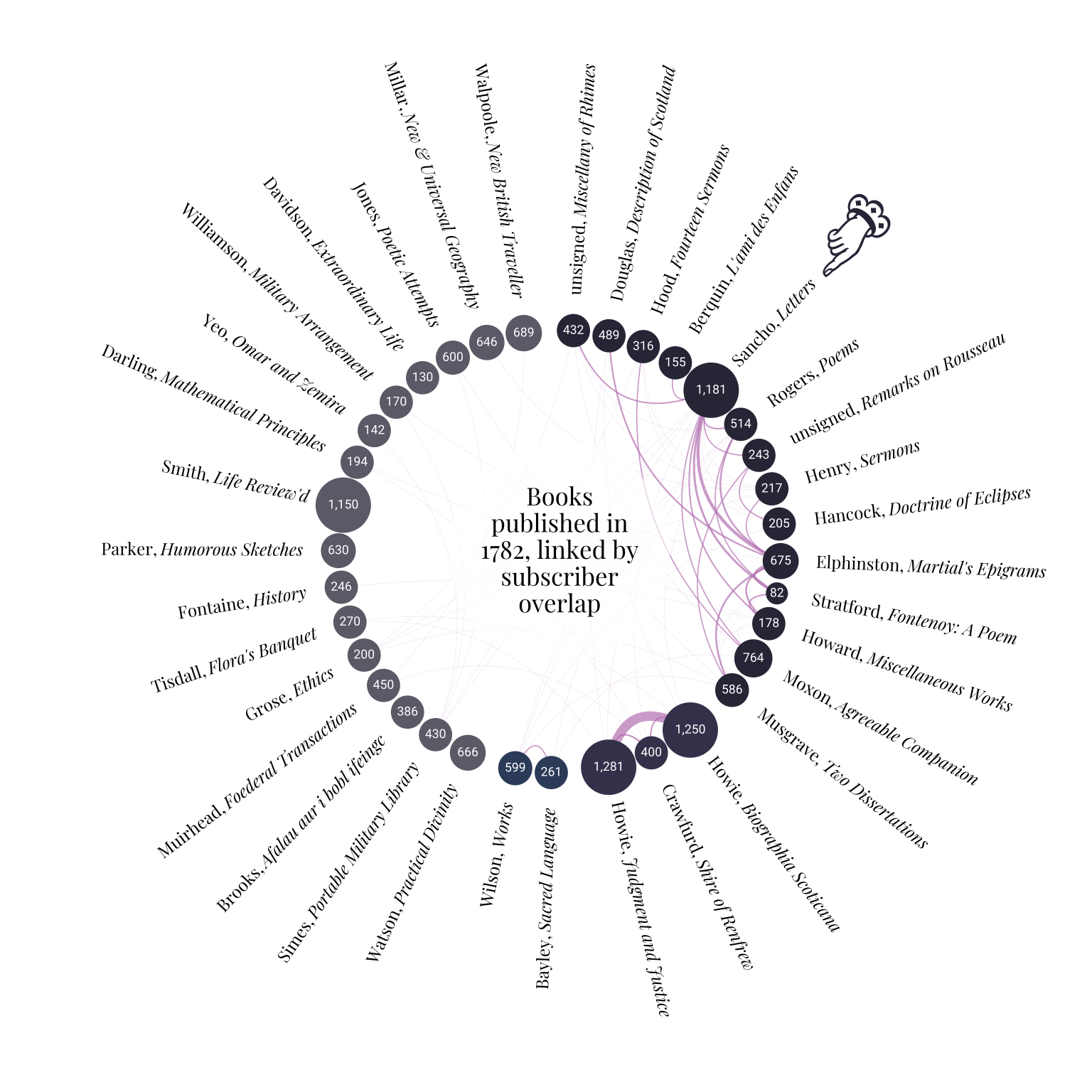
39 of Sancho's subscribers appeared in at least one other list. That number is dwarfed by the 208 people who subscribed to both publications by the Scottish author John Howie, but Sancho's 39 cross-subscribers still represent the most overlap after Howie. Moreover, in the overall network Sancho has the highest betweenness centrality (that is, he is the best 'connector' between different parts of the graph), linked to 14 other works. His greatest overlap is with a translation of Latin epigrams by the ancient poet Martial (they share 17 subscribers). In this view, Sancho's Letters sit at the heart of a cluster of London-based publications with elegant subject matter.
Three Black Britons
Sancho’s Letters, Equiano’s Interesting Narrative, and Cugoano’s Thoughts and Sentiments
The second "view" (as promised in the title) is of Sancho alongside two other Black Britons who also published by subscription, Olaudah Equiano and Ottobah Cugoano. As Black Britons, they were considered "countrymen" in 18thC abolitionist discourses, and are often examined as peers today, but their overlap shows less interconnectedness than between Sancho and the 1782 works: Sancho's overlap with Equiano is less than half his overlap with a Latin translation, and he shares no subscribers at all with Cugoano.
| shared subscribers | Sancho | Equiano | Cugoano |
|---|---|---|---|
| Sancho, Letters 1,181 | — | 8 | 0 |
| Equiano, Interesting Narrative 1,604 | 8 | — | 1 |
| Cugoano, Thoughts & Sentiments 167 | 0 | 1 | — |
This narrower question still rewards manual work: it will always require individualized historical research to identify (for example) that Equiano's subscriber "Richard Cosway, Esq." is the same person as Cugoano's subscriber "Mr. Cosway, Stratford-place": a particularly interesting connection because Cosway was Cugoano's employer. Nonetheless, the code pipeline improves the scalability of these individual discoveries, as manually-recorded matches are kept and used for future entity resolution. In other words, if "Richard Cosway, Esq." is found in a third book, that entry will automatically link not just to Equiano but to Cugoano as well.
The code is open source!
The value of the method is that it can scale, and possibly even generalize (to other 18thC lists -- perhaps petitions?). Because the rules here are explicit and documented, they can be inspected, contested, and re-tuned for the conventions of a new corpus. The pipeline is published on GitHub, and I hope it can be useful to historians with list-shaped sources of their own:
Other related publications
- "Sancho’s Network of Subscribers," in The Cambridge Companion to Ignatius Sancho, eds. Nicole N. Aljoe and Kristina Huang (2026).
- "Book Subscribers of Formerly Enslaved English Authors" (dataset publication), with Alisa Chen, Journal of Slavery and Data Preservation 6.4 (2025).